Reduce operating costs and produce more crops with the most efficient farm irrigation system
The average farmer faces many obstacles when trying to grow a successful and reliable crop from their land. Challenges such as rolling topography, odd-shaped fields and elevation changes, unreliable weather patterns, excessive water waste, and nutrient leaching are too familiar. The amount of fertilizer spent trying to add nutrients back into the soil can be up to 30-40% of operating costs! Finding an irrigation method that efficiently solves all these problems can seem impossible. Over the past four decades, drip irrigation has evolved and has proven itself superior to other irrigation methods. Unlike systems with a saturated water flow (such as sprinklers), drip irrigation systems emit low volumes of water and nutrients directly into the soil in a uniform and precise way to every plant across the entire field.
SDI CAN INCREASE YIELDS UP TO 50%
As a result, drip irrigation increases crop production, yield, quality, and accelerates maturity. All while using considerably less water than other irrigation methods such as sprinkler, centre pivot, lateral hose, etc. As drip irrigation became more popular, different types of drip emitters and methods were developed. Today, the most advanced and proven method is called “subsurface drip irrigation”.
Subsurface drip irrigation (SDI) is an evolution of conventional irrigation systems and provides the grower with many added benefits to surface drip methods. These include eliminating surface evaporation, preventing weed germination, eliminating herbicide washout, reducing crops stress, and more.
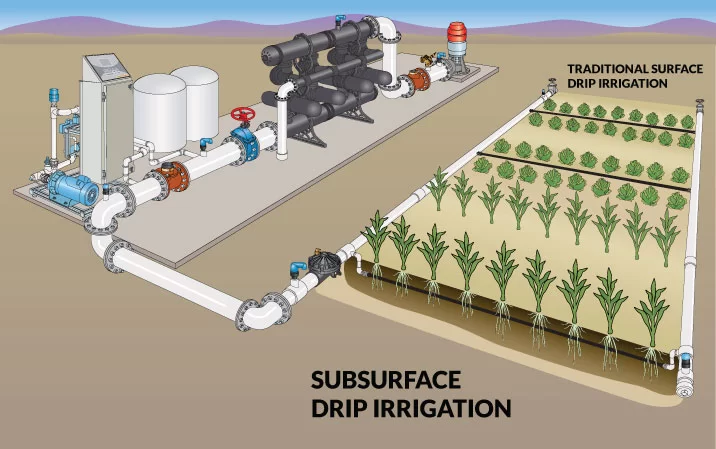
Interest in SDI has grown rapidly in North America within the last 25 years, as innovations from Netafim have made subsurface drip irrigation the most advanced, modern method for irrigating agriculture crops. SDI is used especially by growers in areas where water is scarce or where increased efficiencies and higher quality crops are desired.
Refinements to the installation procedure, lower overall costs, and enhanced product qualities have made SDI quite cost-effective. Because of it’s high efficiency and adaptability to tough growing conditions, SDI is now being used throughout the world on a wide range of grain, forage, and fiber crops including alfalfa, canola, corn, cotton, soybeans, and sugarcane.
What is Subsurface Drip Irrigation?
SDI is where the drip line is buried under the soil surface as opposed to laying on the surface. SDI consists of flexible polyethylene (PE) tubing with emitters welded to its inside wall. These drip lines are permanently buried in the soil in rows 30-60” apart, at a depth of 8-16”, depending on the soil type and the plant’s root structure.
Water is pumped, under low pressure, through a filtering system to the drip lines. These PE driplines are available in many different configurations to meet your unique crop, water, and soil conditions. The drip emitters slowly release very specific and uniform amounts of water directly into the root zone of the plant.
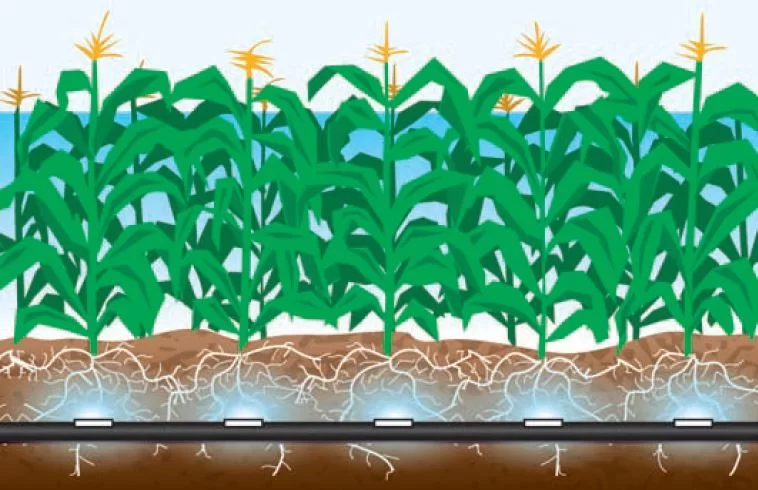
This controlled and precise method of emitting water allows the plant to uptake most of the water that is sent into the system. The water travels through the soil and into the root zone of the plant, pulled by capillary action.
Maintain Optimal Soil Moisture with an Effective Root Management Tool
Subsurface drip irrigation is not just an irrigation system; it is also a root zone management tool. All plants transpire, and the soil also loses water through evaporation, which will vary depending on environmental conditions such as temperature, humidity, and wind. Together, these losses are called evapotranspiration (ET).
Plants perform at their best if soil moisture is at 40-80% (100% being the saturation point, and 20% being the wilting point). Therefore, if soil moisture can be maintained within this range, a crop will have more vitality, produce more and better fruit, and experience very little stress.
Further, for a plant to take up nutrients from the soil, oxygen is required. The goal then, is to ensure optimal moisture in the soil and optimal air concentration, so that the yield and quality of the crops is maximized while shortening growth cycles. Since we are not able to control the atmosphere, we must control the soil.
“SDI USES 20-40% LESS WATER THAN AN
EFFICIENT SPRINKLER SYSTEM OR CENTER PIVOT”
Flood irrigation, and many sprinkler systems, saturate the soil. This means the soil’s pores are full of water and most of the air is pushed out, effectively suffocating the plants and making it unable to generate the energy to take in nutrients.
In an SDI system it is never necessary to saturate the soil, and it allows you to react quickly to various environmental conditions – providing the optimum combination of moist soil and oxygen concentration. Sometimes stressing a plant (for example, to trigger flowering or ripening) is a needed management technique. Subsurface drip irrigation allows this technique to be accomplished quicker and with greater control.
Reduce Water and Energy Usage, and Environmental Impact
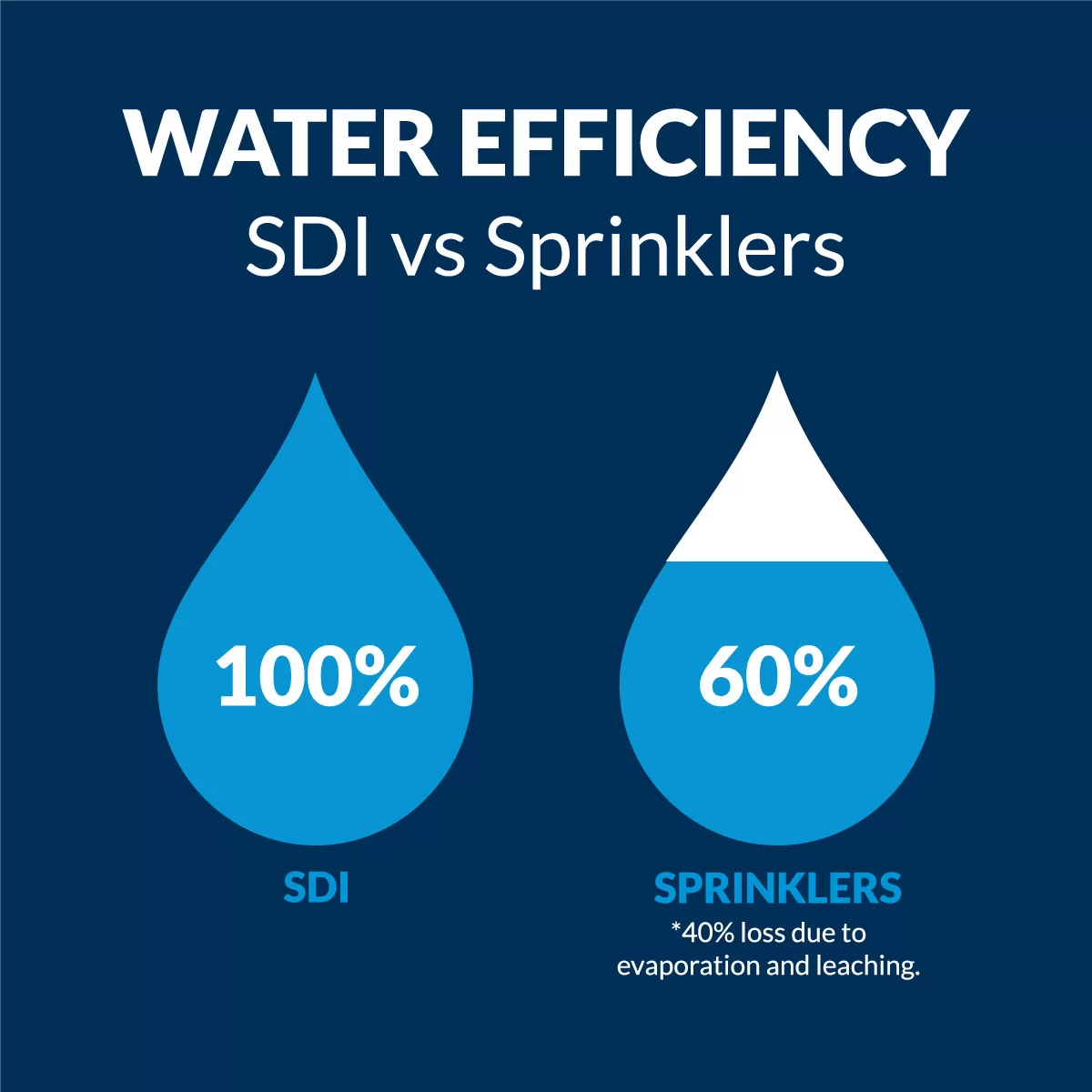
Applying water onto the surface in hot dry or windy conditions results in 20-40% evaporation before the water even enters the soil. Although cost effective, most conventional sprinkler systems apply water at a rate where the soil is unable to absorb it fast enough, resulting in run-off, erosion, and saturation. Many farmers have switched to SDI to use its significant water savings. SDI uses 20-40% less water than an efficient sprinkler system or center pivot, and up to 60% less water than conventional flood irrigation methods. Because an SDI system operates at lower pressures, energy costs can easily be as much as 60% less than a sprinkler system. SDI doesn’t lose any water to evaporation, utilizing almost 100% of the water it emits.
Increase Fertigation Effectiveness and Reduce Fertilizer Needs
A concentrated root zone has a much higher density of roots in any given unit of soil and the effectiveness of the fertigation supplied to the soil is much greater. With an SDI system, fertilizer can be applied to the root zone when it will be most beneficial – resulting in greater use efficiencies, better crop performance, and improved crop yields.
The lower application rate of SDI also prevents the leaching of minerals from the root zone into the groundwater and prevents run-off water which can carry pesticides and fertilizers. Fertilizer requirements can be reduced by as much as 25-40%. Since the system is underground, fertigation can also continue without interruption and multiple operations can take place, simultaneously.
Create a More Natural Growing Environment with Less Herbicides and Pesticides
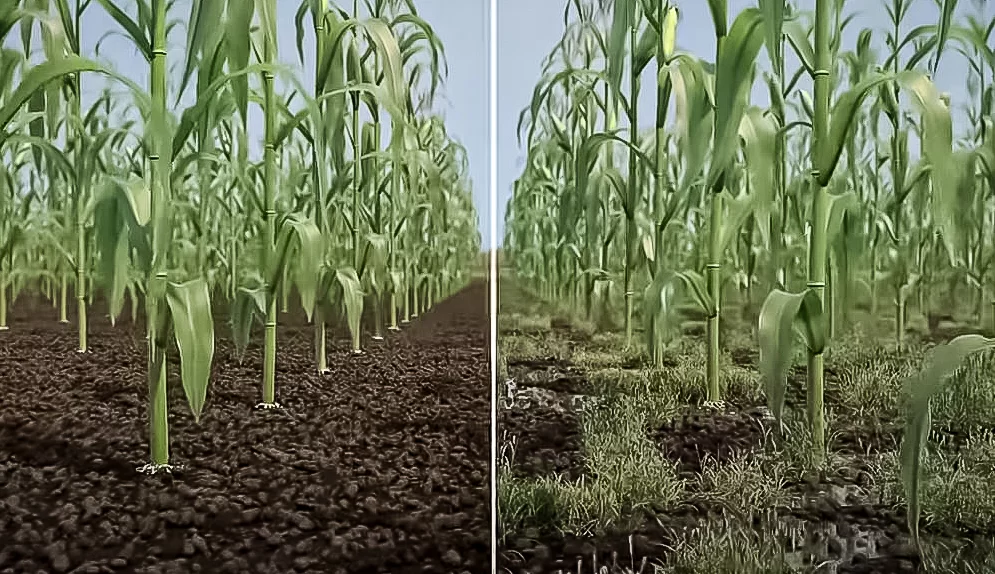
With the use of subsurface drip irrigation, the wetted surface is virtually eliminated. The drier ground minimizes weed development. This reduces tilling and spraying, which ultimately reduces costs for pesticides and herbicides and provides a more natural growing environment. There is no need to damage your crops for fertilizer applications, as the fertilizer (and in some cases herbicides and pesticides) can be applied directly through the drip system. There are no pivot tracks, and machine work can easily be done in straight rows.
Adapt to Any Field, Soil Type or Topography
Central to the SDI advantage is its adaptability to any field shape, size, soil types, and topography. SDI is especially versatile with difficult terrain, whether it’s undulated, sloped, irregularly shaped, or holds meandering rivers, streams or canals. Growers find themselves switching to SDI, as it covers other areas of the field that older systems cannot, increasing their irrigable acreage.
NOTE: It is important to have your system designed by experienced professionals who understand the numerous variables that must be considered when customizing your SDI system to your specific field type, or your system may not perform as intended.
Increase Recurring Revenue with Better Product Quality and Higher Yields
SDI reduces deep leaching of plant nutrients and maximizes the quality, texture and taste of your products, improving the return rate of your customers. This provides your business with a more predictable and consistent revenue stream, higher customer lifetime value and allows you to plan for more growth opportunities.
Proven Yield Results with Independent Case Studies
On average, crop yields can be increased between 10 to 50% using SDI. For example, the average yield for seed alfalfa is around 500lbs per acre. One of Southern Irrigation’s test projects yielded up to 900lbs — an 80% yield increase! Another project with seed canola resulted in a 20% increase in yield compared to an adjacent plot planting under pivot irrigation. These positive results were due to SDI’s proper moisture application and timely nutrient application.
A case study was done in Southern Colorado, where a grower had adopted the SDI method on his field of 171 acres for a variety of crops, including melons, onions, peppers, tomatoes, corn, alfalfa, beans, and small grains. He chose an SDI system as it allows for more control of water and nutrient application, as well as other farming operations. He had hoped to realize improved crop yields and quality, reduced fertilizer application, and a reduction in disease and pest problems.
He could not have been more pleased with the results using subsurface drip irrigation and his water savings have been impressive. For example, 3 to 4 acre-ft of water was required for each acre of melons using flood irrigation. With SDI, the grower now uses just 1 acre-ft per acre. Fertilizer applications have been reduced by 30% and crop yields have improved by at least 40% across the board. The quality of the produce has also improved, especially the melon crops.
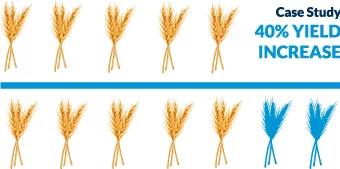
Although this grower originally set out to save water, in the end he found saving water can result in many other benefits including increased yields, higher quality crops, lower fertilizer input, and less environmental impact. In short, his family farming operation is healthier and is better situated to compete down the road with the implementation of SDI technology. (Eckas, 2005)
Another study was done in China for winter wheat crops after the North China Plain faced a water deficit. Lysimeter experiments (measuring the amount of actual evapotranspiration which is released by plants) were conducted under different irrigation methods – flood, surface drip and subsurface drip irrigation.
Subsurface drip irrigation reduced evapotranspiration by 26% compared to flood irrigation, and 15% compared to surface drip irrigation, with significant grain yield and biomass formation due to decreased evaporation losses. Grain yield, yield components, and above ground biomass were similar in subsurface drip and flood irrigation. However, these biomass parameters were lower with surface drip irrigation.
Subsurface drip irrigation also increased the crop water productivity by 25% and irrigation water productivity by 20% compared to flood irrigation. The subsurface irrigated plants showed an increase in net photosynthesis by approximately 10% , higher intrinsic water use efficiency (~36%), lower transpiration rate (~22%), and saved 80 mm of water compared to flood irrigation. (Umair, 2019)
The Southern Irrigation Advantage
Southern Irrigation is a pioneer in the drip irrigation industry, selling drip irrigation in Canada for over 37 years. We are the largest agricultural irrigation supplier in Canada. Because of this, we have the resources to design and install irrigation systems faster, while maintaining quality installations we are proud to stand behind.
Southern Irrigation has the most experience with SDI in Canada on a variety of crops including hemp, canola, seed alfalfa, corn, and more. We have built the expertise needed to work with Canada’s challenging climates and its various types of terrain. Our past projects have been opportunities to test and refine our procedures to offer our customers systems of the highest quality and efficiency. We do this by monitoring system performance, crop results, and taking customer feedback.
Netafim, the inventor of the plastic drip emitter in 1950, is the global leader with advanced, high quality drip irrigation products and components. As modern drip irrigation methods have evolved, producers now depend on Netafim’s drip irrigation advancements to help them improve yields while also reducing water, energy, labor, and nutrient costs. Southern Irrigation works closely with Netafim to make continuous improvements and have established ourselves as the leader in Canada’s Ag-irrigation industry.
Excellent irrigation design, installation, maintenance, and advice combined with Netafim’s advanced drip irrigation products, ensures a reliable SDI system that provides great efficiency and return on investment.
References
Eckas, W. E, 2005, Case Study: Subsurface Drip Irrigation in Southeastern Colorado, July 3, 2020 <https://www.irrigation.org/IA/FileUploads/IA/Resources/TechnicalPapers/2005/2005IrrigationShowTechnicalPapers.pdf page 92>
Umair M, Hussain T, Jiang H, Ahmad A, Yao J, Qi Y, Zhang Y, Min L, Shen Y. Water-Saving Potential of Subsurface Drip Irrigation For Winter Wheat. Sustainability. 2019; 11(10):2978.
2020. 2020 Cost Of Production Crops. [ebook] Manitoba Agriculture and Resource Development, p.2. Available at: <https://www.gov.mb.ca/agriculture/farm-management/production-economics/pubs/cop-crop-production.pdf> [Accessed 22 July 2020].